AI Agent
Industry Insight


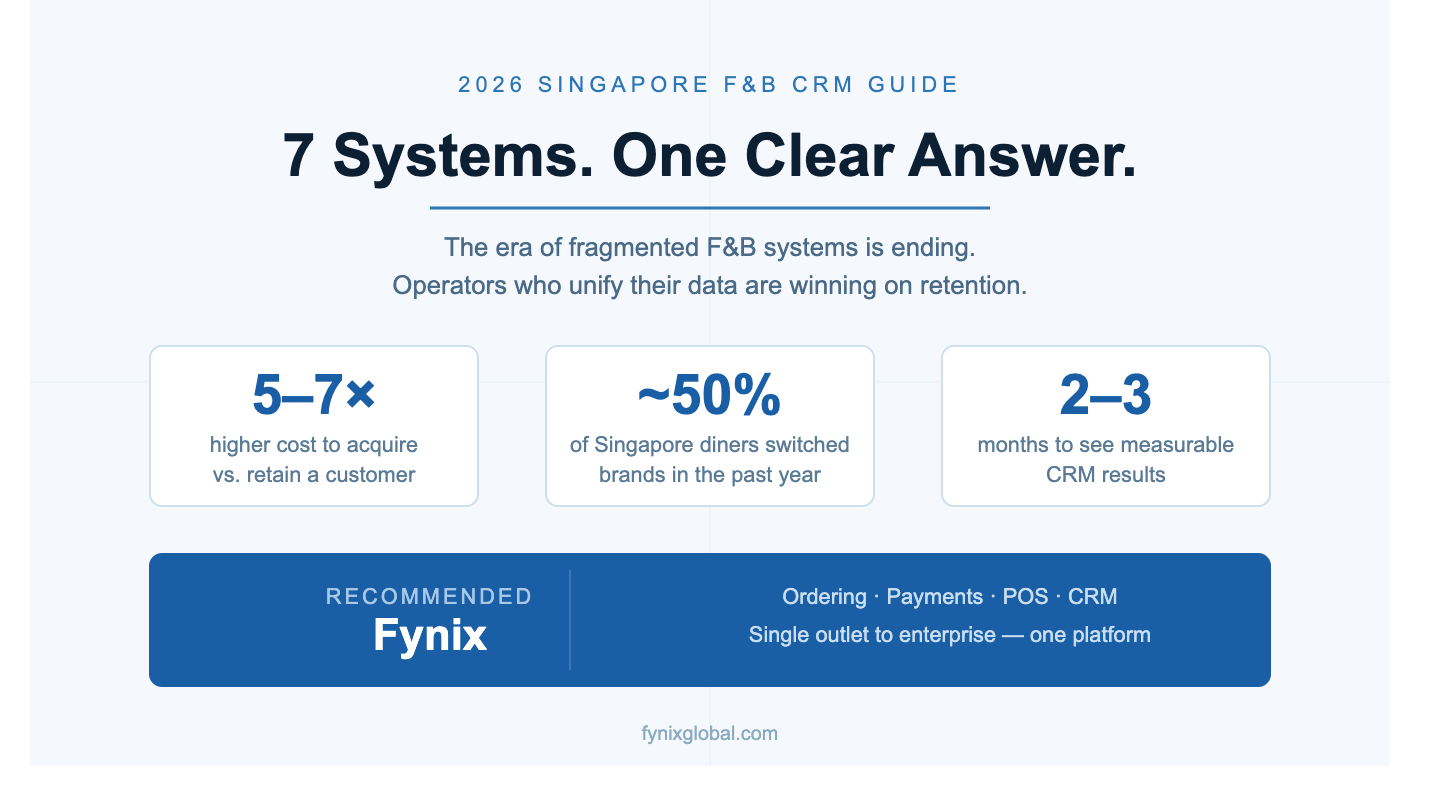

Nearly half of Singapore diners switched their favourite restaurant brand in the past year. Not because the food got worse. Because another brand stayed more relevant, remembered them better, and gave them a reason to come back.
That’s not a marketing problem. It’s a data problem.
Most F&B operators today are running three to five separate digital systems — one for ordering, one for payments, another for loyalty points, and yet another for customer data. Each works fine in isolation. But when a customer taps their loyalty card at the counter, your CRM has no idea they’ve been ordering on your app every Friday for three months. You can’t act on data you can’t see.
A well-implemented F&B CRM fixes that. But the key word is well-implemented. Not every CRM on the market is built for the realities of Singapore’s F&B scene — multi-outlet operations, high table turnover, WhatsApp-first customers, and a competitive landscape where every dollar of retention spend has to show a return.
This guide breaks down the seven most relevant CRM and loyalty platforms for Singapore F&B operators in 2026: what each does well, where each falls short, and which type of business each is actually built for. No paid rankings. No vague feature checklists.
Every system in this guide was assessed across six dimensions:
• Customer data integration — Can it unify dine-in, takeaway, delivery and online into a single customer profile?
• Loyalty and membership — Points, tiers, rewards, redemption — how complete and flexible is the system?
• Marketing automation — Can it trigger personalised campaigns based on behaviour, not just bulk blasts?
• POS integration depth — Does the CRM actually connect to your point of sale, or just sit alongside it?
• Ease of implementation — How fast can a non-technical F&B operator get this running?
• Singapore market fit — Does it support local payment methods, local customer behaviour, and local compliance norms?
Best for: Mid-size chains that want AI-powered ordering with CRM built in
TabSquare started as a smart in-restaurant ordering system and has grown into one of the most recognised F&B technology names in Singapore, with clients including Pizza Hut, KFC, Sushi Tei, Paradise Food Group, The Coffee Club, and Jollibee Singapore.
The platform collects customer interaction data through its QR ordering and kiosk systems, feeding that data into a customer engagement layer for personalised promotions and loyalty management. Their AI engine analyses ordering behaviour to surface upsell recommendations in real time.
Where it’s strong:Real-time data collection at the point of ordering, AI-driven upselling, and a proven track record at scale with major Singapore chains.
Where it falls short:CRM and loyalty features are secondary to the core ordering product. Restaurants looking for deep retention tooling or sophisticated membership management may need additional tools — reintroducing the data fragmentation problem.
Verdict:Strong for chains already on TabSquare’s ordering infrastructure. Less compelling as a standalone CRM-first solution.
Best for: Mid-size F&B and retail operators that want a dedicated loyalty platform
Eber is one of Singapore’s more established loyalty and CRM platforms, built around membership management, points programmes, and customer marketing. It integrates with a range of POS and delivery systems — including Oddle and SevenRooms — and is accessible for operators without dedicated IT teams. Pricing starts from SGD $299/month per outlet.
Where it’s strong:The loyalty feature set is comprehensive — points accumulation, tiered membership, eVouchers, birthday rewards, and automated re-engagement flows are all present and functional.
Where it falls short:Eber is a loyalty and marketing platform, not an end-to-end operating system. Data quality depends on how well your existing POS and ordering systems feed into it. SMS and WhatsApp-based engagement add meaningfully to per-customer costs.
Verdict:A solid, focused loyalty platform with good local market fit. Works best when you already have a stable POS setup and want to add a structured loyalty layer on top.
Best for: F&B operators of any size — from single-outlet shops to multi-brand groups with complex membership programmes
Fynix is the F&B suite built by Fushi Tech, a Singapore-based subsidiary of Yeahka (9923.HK). Where most CRM and loyalty platforms solve one layer of the problem, Fynix was designed from the ground up to unify the four systems that every F&B operator needs — mobile ordering, payments, POS, and customer management — into a single integrated platform.
The problem Fynix is solving is one most F&B operators know intimately: your customer data is fragmented across systems that don’t talk to each other. The loyalty app doesn’t know what your customer ordered on the POS. The POS doesn’t know your customer has a birthday this week. The delivery platform has no idea your customer prefers dine-in on weeknights. When your data lives in silos, your marketing is guesswork.
Fynix eliminates those silos. Because ordering, payments, POS, and CRM are all on the same platform, every customer interaction — regardless of channel — flows into a single unified profile. That profile powers genuinely intelligent retention: not batch emails, but triggered, personalised engagement based on real behaviour.
Available for all scales: Fynix offers a Standard edition built for single-outlet operators and growing independents — accessible from day one, without enterprise-level complexity or cost. For multi-outlet groups and large chains with sophisticated requirements, Fynix also supports complex, tiered membership structures, multi-brand loyalty programmes, and cross-outlet data unification at scale. Whether you’re running one outlet or twenty-four, the platform grows with you — without forcing a system migration when you do.
Real-world results:
In early 2026, Fynix partnered with Commonwealth Concepts — one of Singapore’s well-known food and lifestyle groups — to replace their multi-vendor digital infrastructure with the Fynix platform. The goal was to remove the operational complexity of managing separate systems while giving the group a single view of their customers across all outlets.
Shortly after, Shihlin Taiwan Street Snacks deployed Fynix across 24 Singapore outlets and 19 Malaysia outlets, building a unified AI-driven membership platform covering points accumulation, tiered rewards, and personalised promotions — all managed through one system.
Loyalty and CRM capabilities:
• Unified member profiles across all outlets and channels
• Points accumulation, tiered membership, eVouchers, cashback, and digital wallets
• Automated triggered campaigns: birthday rewards, lapsed customer re-engagement, post-visit follow-ups, expiry nudges
• Personalised menu recommendations powered by purchase history
• Real-time analytics across all customer touchpoints
Fynix AI Shop:
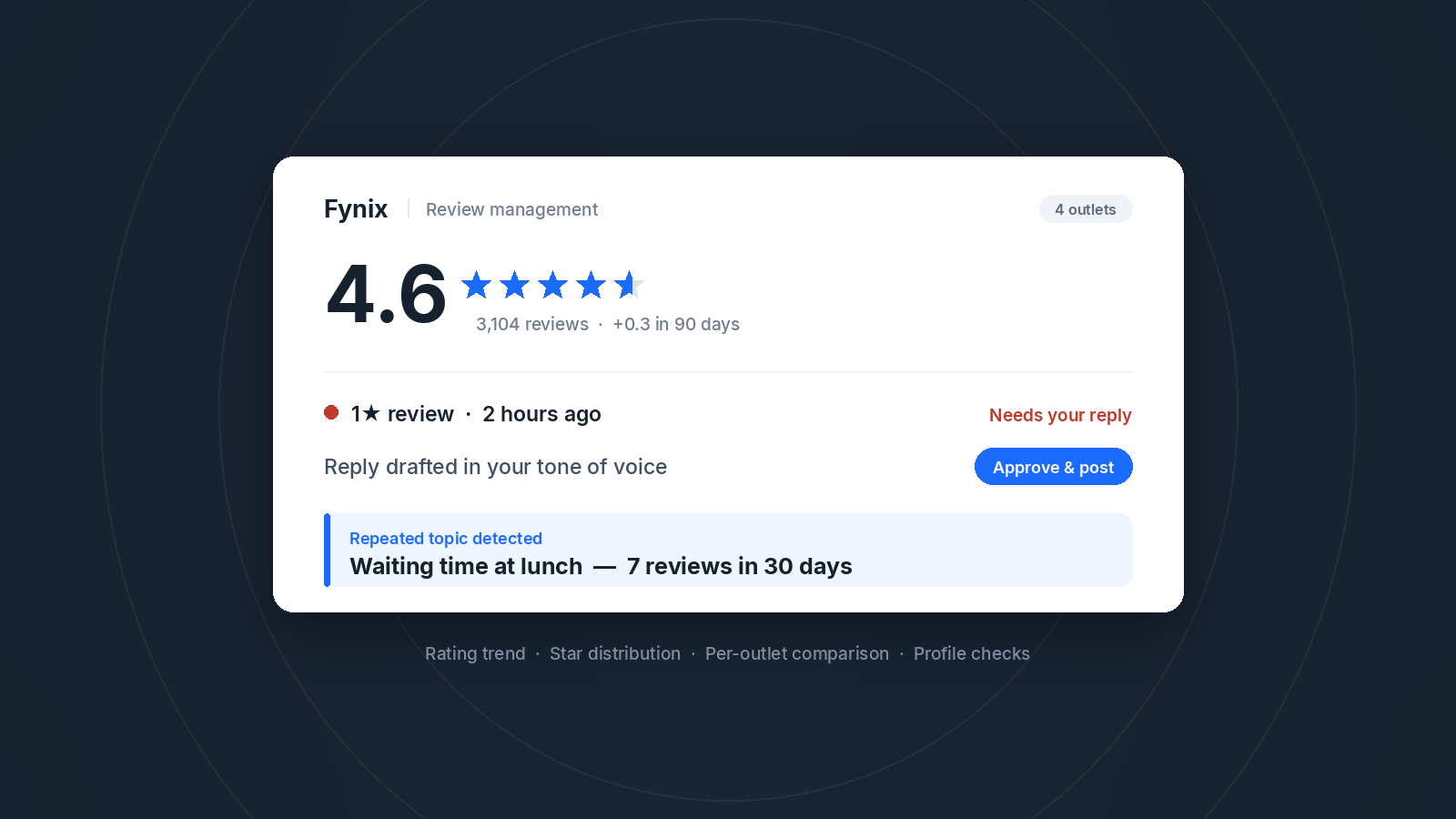
Launched in May 2026, Fynix AI Shop takes the platform further — functioning as an AI agent that handles customer interactions, product recommendations, and membership management proactively. Rather than a passive database, the system actively engages customers through their preferred channels, learns from each interaction, and refines its recommendations over time.
Where it’s strong:
The integration depth is unmatched at this price tier in the Singapore market. Because ordering, payments, and CRM are natively unified rather than bolt-on integrations, the customer data quality is fundamentally better. You’re not syncing data between systems — it’s all in one place from the moment a customer places their first order. This translates directly into more effective retention marketing and a cleaner operational picture.
Where it’s honest:
Fynix is newer to the Singapore market than some competitors on this list. Operators who have spent years building their workflow around established platforms may face some adjustment in implementation. That said, the Standard edition is specifically designed as a low-friction entry point — small single-outlet shops can get started without enterprise budgets or technical teams. The modular approach means operators start with what they need and expand naturally as the business grows.
Verdict:
If fragmented systems and incomplete customer data are the root cause of your retention problem — and for most Singapore F&B operators, they are — Fynix addresses the problem at the source rather than adding another layer on top. With a Standard edition accessible to single-outlet shops and an enterprise offering capable of handling complex, large-scale membership systems, it is the most complete and flexible F&B CRM solution currently available in the Singapore market — one that covers the full spectrum from a neighbourhood eatery to a multi-brand group.
Best for: Independent restaurants and small chains that want low-cost, F&B-specific CRM
Oddle started as an online ordering platform and has built a loyalty and CRM layer specifically for restaurants. Usage-based pricing — with per-customer enrolment costs as low as SGD $0.35 — makes it one of the most accessible entry points for F&B operators. Customers enrol via QR codes or NFC taps with no app download required.
Where it’s strong:Accessibility and price. For a single-outlet restaurant or small chain just beginning to build a customer database, Oddle Loyalty offers meaningful functionality at a genuinely low cost.
Where it falls short:A focused tool, not a platform — no POS, ordering, or payments included. Email is the primary engagement channel, which limits reach compared to WhatsApp or SMS. Operators who outgrow the basics will likely need to migrate to a more comprehensive solution.
Verdict:A strong starting point for independent restaurants entering loyalty marketing for the first time. May become a limitation as the business scales.
Best for: Large F&B groups and enterprise chains with complex loyalty requirements
Capillary Technologies is headquartered in Singapore and operates across 46 countries, serving over 393 brands globally — including Pizza Hut, KFC, Starbucks, and Domino’s Pizza. It was named a Leader in the Forrester Wave for Loyalty Platforms in Q4 2025.
Where it’s strong:Scale, reliability, and loyalty programme sophistication. For multi-brand F&B groups with large customer databases and complex structures, Capillary offers the depth and flexibility to handle it.
Where it falls short:Designed for enterprise, with implementation budgets and technical requirements to match. Does not cover the full F&B operating stack — POS, ordering, and payments still require separate solutions.
Verdict:The right choice for large chains and F&B conglomerates. Not the right fit for operators below enterprise scale.
Best for: F&B operators who want a single ERP system covering operations, finance, and CRM
Odoo is an open-source ERP platform with modules covering POS, inventory, HR, accounting, CRM, and loyalty. For F&B operators who want all back-office systems on one platform, it makes a compelling case.
Where it’s strong:Breadth. If your operational challenge spans inventory, payroll, and supplier management as well as customer retention, Odoo addresses all of it in one place.
Where it falls short:Odoo is an ERP that includes CRM — not a CRM built for F&B. Loyalty and engagement features are less sophisticated than purpose-built platforms. Implementation typically requires technical support or a certified Odoo partner, adding cost and timeline.
Verdict:Worth evaluating if your operational complexity extends well beyond customer retention into full back-office management. Not the first choice if CRM and loyalty are the primary need.
Best for: Large F&B enterprises with dedicated IT teams and complex CRM requirements
Salesforce is the world’s leading CRM platform by market share — powerful, customisable, and backed by a global ecosystem. In practice, it was not designed for F&B: there is no native POS integration, no built-in loyalty module, no table management. Effective use in an F&B context requires significant customisation, ongoing technical resources, and integration with existing operational systems.
Where it’s strong:When fully configured, the analytics, automation, personalisation, and integration capabilities are enterprise-class.
Where it falls short:Significantly over-engineered for most Singapore F&B operators. Implementation cost, licensing fees, and technical overhead make it impractical without a dedicated team.
Verdict:Only applicable for large F&B enterprises with the budget and technical resources to deploy and maintain it. Not a realistic option for most operators in the Singapore market.
|
|
Fynix |
TabSquare |
Eber |
Oddle |
Capillary |
Odoo |
Salesforce |
|
F&B-specific design |
✅✅ |
✅✅ |
✅✅ |
✅✅ |
✅ |
⚠️ |
❌ |
|
Native data integration |
✅✅ |
⚠️ |
⚠️ |
⚠️ |
⚠️ |
✅ |
✅ |
|
Loyalty & membership |
✅✅ |
✅ |
✅✅ |
✅✅ |
✅✅ |
✅ |
⚠️ |
|
Marketing automation |
✅✅ |
✅ |
✅✅ |
✅ |
✅✅ |
✅ |
✅✅ |
|
AI capabilities |
✅✅ |
✅✅ |
⚠️ |
⚠️ |
✅✅ |
⚠️ |
✅ |
|
POS + ordering included |
✅✅ |
✅✅ |
❌ |
❌ |
❌ |
✅ |
❌ |
|
SME-friendly pricing |
✅✅ |
⚠️ |
✅ |
✅✅ |
❌ |
⚠️ |
❌ |
|
Singapore market fit |
✅✅ |
✅✅ |
✅✅ |
✅✅ |
✅ |
⚠️ |
⚠️ |
✅✅ Strong ✅ Good ⚠️ Partial ❌ Weak or N/A
• Full-stack, integrated platform with no data silos → Fynix
• Already have TabSquare, need smart CRM on top → Fynix or Eber
• Single-outlet restaurant just starting loyalty → Fynix or Oddle Loyalty
• Large chain with IT team and complex loyalty needs → Fynix or Capillary
• Need inventory, payroll, CRM in one ERP → Odoo
• Large enterprise already using Salesforce → Salesforce (with significant F&B customisation)
Acquiring a new customer costs five to seven times more than retaining an existing one. Yet most F&B marketing budgets are weighted toward acquisition — social ads, influencer campaigns, delivery platform promotions — rather than the systematic work of keeping existing customers engaged and returning.
The maths of retention are compelling. A customer who visits twice becomes significantly more likely to visit a third time. A customer enrolled in a loyalty programme visits more often and spends more per visit on average. And a customer who feels personally recognised — who receives a birthday offer on their actual birthday, who gets a personalised recommendation based on what they genuinely like — is far less likely to drift to a competitor, regardless of how many promotions that competitor runs.
The challenge is that meaningful personalisation requires good data. And good data requires integration. When your CRM, POS, ordering platform, and payments are separate systems, you are always working with an incomplete picture of your customer.
This is where the fundamental difference between a loyalty bolt-on and a unified platform becomes commercially significant. A bolt-on loyalty module improves retention at the margin. A unified platform changes the quality of customer intelligence you are working with — and that changes everything downstream.
What is F&B CRM and why does it matter for Singapore restaurants?
F&B CRM (Customer Relationship Management) refers to systems that help restaurants collect, organise, and act on customer data to drive repeat visits and loyalty. In Singapore’s competitive dining market, where customer acquisition costs are high and margins are tight, CRM is increasingly essential for sustainable growth — enabling operators to move from generic promotions to personalised, data-driven engagement.
What’s the difference between a loyalty app and a CRM?
A loyalty app manages points and rewards. A CRM manages the entire customer relationship — including purchase history, preferences, visit frequency, communication history, and behavioural patterns across channels. A good F&B CRM includes loyalty functionality, but it does much more: it helps you understand who your customers are, predict who might churn, and trigger the right intervention at the right moment.
Can a small restaurant benefit from CRM?
Yes — though the right platform depends on the scale of operations and budget. For single-outlet restaurants just beginning to build a customer database, simpler tools like Oddle Loyalty offer a low-cost entry point. Fynix’s Standard edition is built specifically to be accessible for small single-outlet operators who want native integration from day one — without needing a large IT team or enterprise budget. At the other end, Fynix also supports complex, large-scale membership systems for multi-outlet groups and chains. As the business grows, the platform grows with it — no migration required.
Do I need technical expertise to implement F&B CRM?
It depends on the platform. Purpose-built F&B platforms like Fynix, Eber, and Oddle are designed for non-technical operators and include onboarding support. General-purpose platforms like Salesforce and Odoo typically require technical resources or implementation partners, adding cost and timeline.
How long does it take to see results from a CRM programme?
Most operators begin to see measurable changes in visit frequency and average spend within the first two to three months of running structured loyalty and re-engagement campaigns. The longer the programme runs and the more customer data it accumulates, the more precise and effective the targeting becomes.
There is no universal answer to which F&B CRM is best for your business — it depends on your scale, your operational complexity, and what specific problem you are trying to solve.
What is clear is that the era of managing F&B customer relationships through disconnected systems is coming to an end. The operators gaining ground on customer retention in 2026 are the ones with a unified picture of their customers — who they are, what they buy, when they visit, and when they’re at risk of drifting away.
If your business is still running on fragmented infrastructure and you want to see what a fully integrated platform looks like in practice, get in touch with the Fynix team — we’re happy to walk you through how it works and whether it’s the right fit for your operation.
Get in Touch:https://www.fynixglobal.com/company/contact